AUCTORES
Globalize your Research

Research Article | DOI: https://doi.org/10.31579/2637-8892/358
1 Associate Professor, Department of Psychology, Faculty of Science, Brandon University, Manitoba, Canada.
2 Professor, LaMarsh Centre for Child & Youth Research, Department of Psychology, York University, Canada.
3 Professor, Educational Scientific Institution, Anshan Normal University, China.
4 Professor, Department of Psychology, University of British Columbia, Vancouver, Canada.
*Corresponding Author: Susan Chang Su, Associate Professor, Department of Psychology, Faculty of Science, Brandon University, Manitoba, Canada. email: sus@brandonu.ca; ORCID: 0000-0002-3702-6008.
Citation: Chang Su, Gordon L. Flett, Lianrong Guo, Paul L. Hewitt, (2026), Cross-cultural study about the relationships among perfectionistic self-presentation, self-construals, shame, social anxiety and social phobia, Psychology and Mental Health Care, 10(1): DOI:10.31579/2637-8892/358
Copyright: © 2026, Chang Su. This is an open access article distributed under the Creative Commons Attribution License, which permits unrestricted use, distribution, and reproduction in any medium, provided the original work is properly cited.
Received: 01 January 2026 | Accepted: 15 January 2026 | Published: 22 January 2026
Keywords: perfectionistic self-presentation, shame, self-construal, anxiety, social phobia
| Past research found perfectionistic self-presentation (needs to appear perfect in the eyes of others and not display/disclosure imperfections in public) correlated with many psychopathologies and seldom linked it with various emotions such as shame, social anxiety, and social phobia cross-culturally. This study examined the relationships among these variables in undergraduate students from collectivist society mainland China and individualistic society Canada. The goal of the present study was to test the relationship among these variables in both non-clinical samples and explore whether the different cultures, and gender roles have a greater impact on three facets particularly nondisplay and nondisclosure imperfections and psychological functioning in mainland Chinese than it does in European Canadians. 126 Chinese undergraduate students were recruited in North University in mainland China (MCs) and 132 Canadians with European descent (ECs) were born in Canada were recruited in York University of Toronto of Canada. Participants were asked to fill out the questionnaires including Perfectionistic Self-presentation Scale, The Experience of Shame Scale, Self-construal Scale, Social Interaction Anxiety Scale (SIAS) and Social Phobia Scale, and demographic information. ECs completed the questionnaires in English online through URPP system of York University. MCs answered the questionnaires which were translated into Mandarin on the paper. Results showed that effects of culture on perfectionistic self-presentation and the emotion variables via two-way multivariate Analyses of Variance. MCs reported higher than ECs on perfectionism self-promotion. MCs were lower than ECs on social anxiety. MCs were higher than ECs on social phobia. Women reported less than men on nondisclosure imperfections. The correlation analyses showed similar patterns in our Chinese and Canadian samples. The nondisplay and nondisclosure imperfections were positively correlated to each other, and also correlated to all the emotion variables, but perfectionistic self-promotion was only correlated to shame, and social phobia rather than anxiety. Our findings indicate that culture and social context also play a significant role on the differences of perfectionistic self-presentation and other emotion variables between two different groups and influence on their well-beings. |
Perfectionism studies have been conducted in the past three decades showed maladaptive and were linked with a variety of adjustment problems, including psychological distress and suicide ideation (Flett et al., 2023; Hewitt et al., 1997; Hill & Curran, 2016; Hill et al., 1997), multiple mental health disorders, including anxiety and depression (Bieling et al., 2004; Hewitt et al., 1996; Mackinnon et al., 2014; Nepon et al., 2016); and eating disorder (Costra et al., 2004). Perfectionist self-presentation is conceptualized as a stylistic dispositional trait, as articulated by Buss and Finn (1987), and is intricately connected to broader trait perfectionism dimensions, particularly self-oriented, other-oriented (demanding others to be perfect) or socially prescribed perfectionism (feeling that people expect them to be perfect) (Flett et al., 1991; Hewitt & Flett, 1991). It reflects a strong need to appear flawless in the eyes of others, emphasizing the expression of one’s presumed perfection to others while rigorously avoiding the public display or disclosure of any perceived shortcomings or imperfections in public (Hewitt et al., 2003; Sherry et al., 2007), and elevating the rumination about interpersonal events (Nepon et al., 2011). It constitutes a pervasive and stable interpersonal orientation and encompasses three distinct, albeit highly correlated facets. The first, perfectionistic self-promotion (PSP), entails actively promoting a public image of perfection and an expression of perfectionist behaviour to others with flawless abilities and engaging in overt displays of perfectionistic behaviour to elicit admiration and respect. Individuals high in PSP frequently accentuate their strengths, successes, and accomplishments to others, purposefully proclaiming these to others to reinforce an image of exceptional competence. The second one is nondisplay of imperfection, reflects efforts by perfectionistic individuals to conceal and avoid displaying imperfection in order to decrease the likelihood of criticism or disapproval. The third facet, nondisclosure of imperfection in public, similarly represents an avoidant interpersonal style, involving the concealment of personal shortcomings or perceived deficiencies in public contexts (Hewitt, et al., 2003). The latter two facets represent primarily protective or defensive orientations aimed at concealing any imperfections. Collectively, these three dimensions function to minimize the visibility of mistakes, preserve an immaculate public persona, and maintain an idealized self-presentation, while simultaneously avoiding any verbal acknowledgment of errors in interpersonal contexts. Individuals exhibiting these tendencies often harbour a pronounced fear of interpersonal rejection or negative evaluation from others. The nondisplay of imperfection facet involves an avoidance of behavioral displays of imperfection, whereas the nondisclosure of imperfection facet entails a reluctance to verbally admit personal shortcomings (Hewitt, et al., 2003). Previous research (Sherry et al., 2007) has demonstrated that perceiving perfectionistic demands and expectations from others, striving to project an impeccably perfect image, concealing perceived flaws are all positively associated with a wide range of personality psychopathologies. Hewitt et al. (2003) further reported that perfectionistic self-presentation is linked to substantial personal and interpersonal distress. The findings revealed that each facet of perfectionistic self-presentation demonstrated unique associations with various maladaptive psychological and relational outcomes (Mackinnon & Sherry, 2012). Perfectionistic self-presentation was also associated with lower social forms of self-esteem, and excessive concerns with others’ evaluation (Hewitt et al., 2003). The expression of perfection clearly involves lower self-esteem and symptoms of anxiety (MacKinnon et al., 2014), and depression (Besser et al., 2010; Hewitt et al., 2003; McGee et al., 2005). Recent study (Agu & Mmaeml, 2023) revealed that three facets of perfectionistic self-presentation positively predicted anxiety sensitivity on 276 undergraduate students. Past studies showed that people strive for absolute perfection and try to hide their mistakes often feel inadequate and ashamed (Chen et al., 2015; Ferreira et al., 2015; 2018; Flett et al., 2023; Oliveira et al., 2017). Shame is a painful self-conscious and devastating self-conscious human emotion characterized by the negative perception that others see the devaluation of the self as inferior, inadequate or unattractive (Gibert, 2002, 2003; Ho, Fu & Ng., 2004; Tangney & Dearing, 2002). Shame involves a negative introspection and evaluation of self as a failure (Fischer & Tangney, 1995; Tangney, 1991, 1994). It is accompanied with stronger sense of worthlessness and powerlessness and blame themselves harshly after wrongdoings and have very negative self-evaluations (Pinto-Gouveia & Matos, 2011). People in shame become more concerned with hiding his/her self from others and used defensive strategies such as rage, contempt, striving for perfection, and denial to minimize these encounters (Kaufman, 1996). Tangney (2002) regarded perfectionists as strict self-evaluators who broaden the range of outcomes that would be perceived as a failure, which leads perfectionists to feelings of shame. Fedewa et al. (2005) found that negative perfectionism correlated positively with state-shame, and shame-proneness. Positive perfectionism negatively correlated to state shame and anxiety. Many researches convinced that shame has connection with psychopathology (Tangney et al., 1995; Tripp & Petrie, 2001). It plays a central role in many mental disorders, such as depression (Kim et al., 2010; Thomas, 2000), anxiety (Fergus et al.,2014; Zhong, 1993; Zhong et al., 2008), eating disorders (Ferreira et al., 2015; 2018; Hewitt et al., 1995; Oliveira et al., 2017). Shame could manifest in several distinct dimensions of the self. A multidimensional conceptualization framework of shame proposed by Andrews and colleagues (2002) delineates three principal forms. Characterological shame entails a global, deeply ingrained negative evaluation of one’s entire self or core identity, often accompanied by the belief that one is inherently flawed or defective (e.g., I am a failure.). It might relate with childhood trauma or abuse, leading to emotional suppression and self-blame, and mental health problems. This form of shame is strongly associated with a range of adverse psychological outcomes; Behavioral shame, by contrast, pertains to negative judgments of specific actions, mistakes, or failures in performance (e.g., I did something bad.). Such shame may prompt individuals to avoid behavioral display of imperfection and conceal perceived shortcomings; Finally, bodily shame involves self-critical feelings and devaluating assessments related to one’s physical appearance; the perceived inability to meet internal or societal bodily ideals can evoke acutely painful experiences of shame (Velotti et al., 2017). Research showed women may adopt maladaptive emotion regulation when experiencing characterological shame (Nyström & Mikkelsen, 2012). Behavioural shame was associated with hostility, lower self-esteem, and guilt (Velotti et al., 2017). Bodily shame was associated with angry feelings, especially for women (Hejdenberg & Andrews, 2011). Previous research has demonstrated that perfectionistic self-presentation is associated with elevated anxiety symptoms (Hewitt et al., 2003), and has emerged as a robust predictor of daily social anxiety (Mackinnon et al., 2014). Social anxiety is characterized by an intense fear of social or performance situations, particularly those involving unfamiliar individuals or evaluative scrutiny (Beidel & Turner, 2007). It involves experiences of anxiety such as emotional discomfort, fear, apprehension, inferiority, or worry) within interpersonal contexts, including social interactions and situations in which individuals are evaluated or scrutinized by others, accompanied by the belief that such evaluations will be negative or humiliating (American Psychiatric Association, 1994). It arises when people drive a perfect impression to others and have self-doubt about their ability to make perfection (Clark, 2005). Flett et al. (1989) found that perfectionism was correlated with trait anxiety and marginally with neuroticism. Hewitt et al. (2003) found that dimensions of perfectionistic self-presentation are generally related to measures of anxiety and that the nondisplay of imperfection dimension was correlated with anxiety symptom. They also found that perfectionistic self-promotion was consistently correlated with measures of social anxiety. Some researchers have found shame might be one of the reasons to cause social anxiety (Okano, 1994; Li et al., 2003, 2005). Zhong et al., 2002; 2003) supported this aspect that shame plays a core role to influence the development of social anxiety (Gilbert, 2000; Jutwak & Ferrari, 1997; Tangney et al., 1995). Experiencing shame can cause social avoidance, distress and social anxiety disorder (Fergus et al., 2010). Shame involves perceptions that others view oneself as negative personal characteristics and negative evaluations such as a strong sense of worthlessness and powerlessness (Qian et al., 2001). Shame proneness was positively correlated with social anxiety, and the decreasing of shame proneness had good effects on reducing individual’s social anxiety (Li et al., 2005). Shame proneness intervention is effective on the improvement of social anxiety level (Li et al., 2006). Over half of the social anxiety events were related with shameful events (Hirshfeld-Becker, Fredman, Robin, & Rosenbaum, 1999). The essence of social anxiety has been said to be an expectation of negative evaluation by others (Leitenberg, 1990). One theory is that social anxiety occurs when there is motivation to make a desired impression along with doubt about having the ability to do so (Leary, 2001). Excessive levels of nondisplay and nondisclosure of imperfection will appraise social environments as threatening, and have fears of making public errors (Arkin, Appelman, & Burger, 1980). For some social anxious individuals, nondisplay and nondisclosure of imperfection may be a consequence of social anxiety. Feeling of shame is a key factor to cause social anxiety when people interact with others. More shameful events in the reality increased and caused individuals to have anxious behaviours, and they are more likely to avoid from the reality and further have social anxiety problems (Li, Qian, & Zhong, 2005). Researchers have found that shame and social anxiety shared some similarities. They both tend to perceive things negatively and have social withdrawal and avoided behaviours, people with both or either shame-proneness or social anxiety are more susceptible to negative feelings such as anxiety, fear, and depression (Li, et al., 2005; Qian et al., 2001; Tangney, 1995; Tangney et al., 1992).
Cross-cultural study
Culture encompasses shared common values and beliefs that shape how individuals interpret the social world, as well as a set of practices that arise from them (Triandis, 1995). Research has documented differences in the cognitive and emotional styles of individuals from Eastern cultures and Western cultures. Two influential theoretical frameworks include individualism-collectivism (Hofstede, 1980, 1994) and independent-interdependent self-construal provide a robust basis for understanding how members of different cultural groups construct their interpersonal relationships (Markus & Kitayanma, 1991). Eastern cultures are generally characterized as collectivistic, prioritizing group interests, hierarchical relationships and a sense of belonging. In contrast, Western cultures tend to be more individualistic, emphasizing autonomy, personal freedom, individual achievement, and self-interests. Markus and Kitayama (1991) conceptualized interdependent self-construal as rooted in close, relational social ties, whereas independent self-construal is characterized as stable, distinct and relatively decontextualized from social relationships. Prior research (Cross & Madson, 1997) has further suggested that Western societies tend to socialize males toward independence and autonomy, while females are more often encouraged to adopt interdependent orientations. In many Asian cultures, such as mainland China, social roles have been shaped by Confucian traditions for over thousand years (Tu, 1985). Within this framework, men have traditionally been expected to lead the household, whereas women are expected to serve, follow and obey male authority. Much of the Confucian tradition continues to influence contemporary Chinese society (Tu, 1985). Consequently, cultural differences and gender role expectations may exert a stronger influence on three facets of perfectionism-particularly nondisplay and nondisclosure imperfection and on psychological functioning among mainland Chinese individuals than among European Canadians. This pattern may be partly explained by evidence suggesting that individuals in Eastern cultures are more likely to engage in self-critical tendencies (Heine et al. 2000), and try to avoid losing face, and Westerners tend to engage in self-enhancement (Chang et al., 2001; Heine et al., 1999). Westerners showed optimistic bias positive to the negative outcomes (Chang & Asakawa, 2003), in contrast, Japanese showed pessimistic bias for negative outcomes, therefore European Canadians might be positive for not showing perfect in front of people than mainland Chinese when they are in negative situations. Chang and Chang (2009) examined the effects of socially prescribed expectation on emotions and cognitions in Asian and European Americans and European American participants. Their findings indicated that priming participants with negative outcome expectancies led to higher levels of negative perfectionisms and lower levels of positive perfectionism. Asian Americans reported lower levels of subjective well-being and higher levels of negative perfectionism than European Americans. Similarly, Xie, Leong and Feng (2007) found that socially prescribed perfectionism was a better predictor of social anxiety among Chinese participants, whereas it was a stronger predictor of trait anxiety among Caucasian participants. Experiences of shame have been observed across nearly all cultures; however, the subjective experience of shame may comprise different components depending on cultural context. Cross-national studies suggest that Asian parents are more likely than European American parents to rely on practices such as love withdrawal, shame, and guilt induction (Wu et al., 2002). Zane and Yeh (2002) found that Asian American college students reported stronger motivation to avoid loss of face compared to their European Americans counterparts. In Western cultural contexts, shame has been linked to the development of social anxiety (Chorpita & Barlow, 1998). Some cross-national data suggests that shyness or social anxiety may be viewed as normative, consistent with socialization goals, and distinct from other adjustment difficulties in Asian cultures (Chen, Rubin, & Li, 1995). Moreover, there are ethnic differences in the experience of social anxiety, with replicated findings of Asian American college students reporting higher levels of social anxiety symptoms than European American students (Okazaki, 1997, 2002; Okazaki, Liu, Longworth, & Minn, 2002). However, research on Asian Americans suggests that their experience of social anxiety is associated with both subjective distress and functional impairment (Hsu & Alden, 2007). Chinese participants tended to have elevated scores on self-reported anxiety measures than participants from Western countries (Chataway & Berry, 1989; Chen, 1996). China has been referred to as the shame-society by some social and behaviour scientists, and advocates Chinese people should have the sense of shame. Shame has a more important effect on social anxiety in Chinese culture, compared to its effect on Americans (Zhong et al., 2008). The experience of shame should be influenced by culturally-determined moral styles, social norms, and people’s self-concepts (i.e., interdependent self, independent self). Independent self-construal is defined as a bounded, unitary and stable self that is separated from social context, whereas interdependent self-construal refers to a flexible and variable self that emphasizes social contexts such as interpersonal relationships, status and roles (Singelis, 1994). Okazaki (1997) found that independent self-construal as a significant (negative) predictor of social anxiety, but not depression. The positive correlations exist between interdependent self-construal and anxiety, the more interdependent, the greater the tendency that one may monitor other’s evaluation. Therefore, interdependent self-construal might be strongly related with social anxiety for mainland Chinese than European Canadians. Different self-construals might influence various reactions to shame situations, which might different levels of social anxiety and social phobia.
Study hypotheses
In China, a substantial body of research has examined the characteristic of the perfectionism following the revision of the Experience Shame Scale was revised by Qian et al. (2000). However, the perfectionist self-presentation (PSPS) has received relatively little scholarly attention, Zhang et al. (2007) revalidated the PSPS scale in Chinese context and explored its relationship with self-esteem. This project is distinctive in that it is the first to simultaneously investigate perfectionistic self-presentation and experience of shame, as well as their associations with social anxiety. Individuals who experience shame are often characterized by heightened self-blame, tendencies to attribute blame to others, and a strong motivation to avoid shame-eliciting situations. For individuals who strongly endorse perfectionistic self-presentation, such situations may be particularly distressing, imposing greater psychological strain and potentially exacerbating symptoms of social anxiety. If young people cannot recover from this negative emotion quickly, they might seal themselves off from others and may even develop anti-social or violent tendencies (Lutwak & Ferrari, 1997; Tangney, 1994; Anolli & Pascucci, 2005), and mental health problems (Thomas, 2000; Zhong, 1993). Specially, for individuals who engage in perfectionistic self-presentation during interpersonal communication, greater tendencies toward nondisclosure (i.e., concealing imperfections) and nondisplay (i.e., avoiding the display of imperfections), combined with a failure to present themselves as perfect to others, are likely to intensify feelings of shame regarding their behavior in such situations. Furthermore, in the absence of effective coping strategies, situation that expose their flaws may exacerbate emotional distress and heighten levels of social anxiety. To date, no empirical cross-cultural research has examined the relationships among perfectionistic self-presentation, shame, and social anxiety in non-clinical samples of Chinese and European Canadians. Building on prior literature, the present study seeks to integrate these constructs to investigate whether the need to appear perfect, in interaction with shame elicited by perceived wrongdoing, predicts heightened symptoms of social anxiety. In particular, individuals from distinct cultural backgrounds, characterized by differing self-concepts (e.g., interdependent versus independent self-concept) might influence their feeling shame in divergent ways and exhibit varying strength of association among these variables. In summary, the primary aim of this study is to examine the relationship among these factors in non-clinical samples of Chinese and European Canadians. Specifically, we would investigate whether the need to present a flawless image and the experience of shame differ across these two cultural groups in their association with social anxiety. Regression analyses and multivariate analyses of variance (MANOVA) would be employed to test the proposed relational model among the three constructs of perfectionistic self-presentation and to compare and identify their similarities and differences between Chinese and European Canadian models. We hypothesized that all three facets of perfectionist self-presentation would significantly correlate with experience of shame, and social anxiety. In particular, we expect that Chinese participants who disclose perceived wrongdoing in interpersonal contexts would experience heightened shame, which in turn would be positively associated with greater social anxiety. Furthermore, we predicted that interactions between perfectionist self-presentation and interdependent self-construal interactions would significantly elevated levels of shame, and social anxiety. Also, there would be cultural differences between European Canadians and mainland Chinese about perfectionistic self-presentation with either interdependent self-construal or independent self-construal on experiencing shame, and social anxiety. Because people from mainland China with interdependent self-construal might be sensitive for social environment, take more pressures from the surroundings, and focus on more evaluations from others, they might have higher social anxiety, and more shame than Euro-Canadians.
In summary, the hypotheses of this study were listed as follows:
Hypothesis 1: The relational model encompassing perfectionistic self-presentation, shame, social anxiety, social phobia, interdependent and independent self-construal was expected to differ between Chinese and European Canadian samples. Drawing on existing the theory and empirical evidence, the interpersonal dimension of perfectionism-specifically perfectionistic self-presentation would be hypothesized to exhibit distinct patterns of association with shame, social anxiety, self-construals across cultural groups. More specifically, with respects to the three facets of perfectionistic self-presentation, it was anticipated that perfectionistic self-promotion would be negatively associated with shame, social anxiety, social phobia and interdependent self-construal, and positively linked with independent self-construal in European Canadian participants. In contrast, among Chinese participants, and perfectionistic self-promotion would be positively linked with interdependent self-construal and negatively linked with independent self-construal. Furthermore, nondisclosure and nondisplay imperfections would be hypothesized to be positively related to experience of shame, and social anxiety, social phobia as well as to independent and independent self-construal, in both European Canadian and Chinese samples.
Hypothesis 2: Cultural differences are expected to emerge across the three facets of perfectionistic self-presentations, as well as in levels of shame, and social anxiety or social phobia. Specifically, individuals from Mainland China would be anticipated to report higher levels of perfectionistic self-promotion and greater experiences of shame than their Euro-Canadians. In contrast, Mainland Chinese participants would be expected to report lower levels of nondisplay and nondisclosure imperfections than European Canadians. This may be because European Canadians who strive to appear flawless and actively avoid revealing imperfections may experience greater psychological strain in challenging interpersonal situations, leading to heightened anxiety, fear, and avoidance behaviors. Moreover, shame is generally regarded as a maladaptive emotion in Western cultural contexts, whereas in Eastern cultures such as China, shame is often considered a more adaptive and socially regulating emotion. Consequently, these cultural distinctions are expected to contribute to systematic differences across perfectionistic self-presentation, shame, social anxiety and social phobia related outcomes.
Hypothesis 3: Interdependent self-construal would be expected to function as a mediator in the relationships among perfectionistic self-presentation, experience of shame, and social anxiety or social phobia within the Chinese sample, but not within the European Canadian sample. In addition, the present study examined potential interaction effects among these variables. Gender difference in self-construal would be also anticipated, with females might be expected to endorse higher levels of interdependent self-construal, whereas males might be expected to report higher independent self-construal.
Participants: The sample consisted of 126 Chinese undergraduate students (63 males; 63 females) from a North University of mainland China located in Anshan city. Participants had a mean age of 19.87 years (SD = 0.53). All participants were volunteers to take part in the study and provided informed consent. Upon completion of the surveys, participants received a debriefing sheet in Mandarin and a small monetary gift (approximately $5 Canadian). In addition, 132 European Canadian undergraduate students were recruited from the undergraduate participant pool in York University in Toronto, Canada (70 males; 62 females; Mean age = 20.55; SD = 4.64). All European Canadian participants were born in Canada and identified as being of European descent. They were given the consent form and the package of the surveys online.
Measurements:
Procedure
Chinese participants were recruited from undergraduate students in North University in mainland China and were administered by the experimenters in different class. Participants were asked to sign the consent form and complete the questionnaire package in 45 minutes if they agreed to participate. They received a debriefing form and 5$ or equivalent gift from the experimenter.
European Canadian participants were recruited from the undergraduate participant pool at the York University. They answered the questionnaires online through URPP system of York University. After they submit their answers, each participant received a 1% bonus added to his/her final course grade.
Analysis
In this cross-sectional design study, the software’s IBM SPSS Statistics 26.0 were used. The descriptive statistics, MANOVA, Pearson correlation analyses, and regression statistic method were performed separately to study the relationships among all these factors for the Chinese and European Canadian samples.
Relationships between perfectionistic self-presentation, experience of shame, social anxiety, social phobia and interdependent/independent self-construal All of the variables were centered prior to analyses. In this way, the risk of multicollinearity was reduced. Pearson correlations were calculated for each of the independent variables including perfectionistic self-promotion, nondiplay of imperfections, nondisclosure of imperfections, characerological shame, behavioural shame, bodily shame; dependent variables including social anxiety, and social phobia; and controlling variables (interdependence self-construal, independence self-construal). The correlation analyses are first reported with the four cultural groups combined (see Table 1), and then with the two groups separately (see Table 2, Table 3).
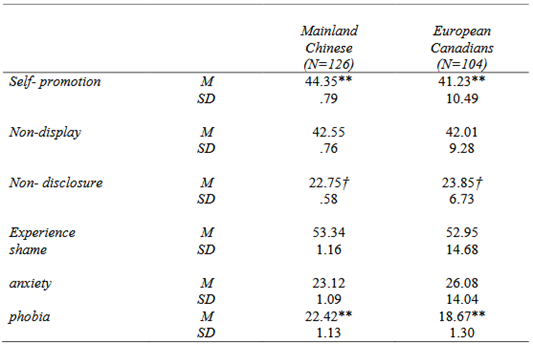
** p < .01***. p < .001. † 0.5 < p <.10.
Table 1: Means and standard deviations of perfectionistic self-presentation, shame, loss of face, anxiety, and social phobia by culture group..

* p < .05. ** p< .01*** p < .001. † 0.5< p <.10.
Table 2: Correlations of all the predictors and outcome variables in two cultural groups Chinese students (N = 126) are above the diagonal; Euro-Canadian students (N = 104) are below the diagonal.
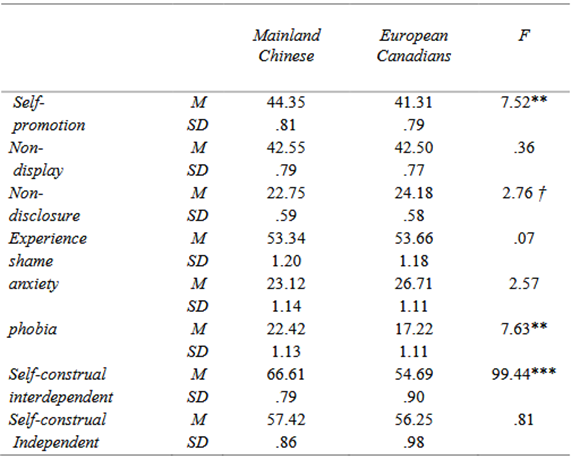
* p < .05. ** p < .01*** p <.001. † 0.5< p><.10.
Table 3: Means and standard deviations of perfectionistic self-presentation, shame, anxiety, social phobia, and self-construals by cultural groups.
Correlations between two individual variables and other variables by group
For the correlations in the mainland Chinese group, (see Table 2), perfectionistic self-promotion was positively correlated with nondisplay of imperfections (r=.42, p=.00), with nondiscolsure of imperfections (r=.26, p=.00), with bodily shame (r=.19, p=.04), and with social phobia (r=.20, p=.02). Nondisplay of imperfections was positively correlated with nondiscolsure of imperfections (r=.40, p=.00), with characterological shame (r=.35, p=.00), with behavior shame (r=.21, p=.00), with overall shame (r=.29, p=.00), with social anxiety (r=.21, p=.02), and with social phobia (r=.20, p=.02). Nondiscolsure of imperfections (r=.45, p=.00), was positively correlated with social phobia (r=.21, p=.02), and was negatively correlated with independent self-construal (r=-.20, p=.02) (see Table 2). Overall shame was positively correlated with social anxiety (r=.56, p=.00), with social phobia (r=.64, p=.00), and was negatively correlated with independent self-construal (r=-.22, p=.00) (see Table 2). Characterological shame was positively correlated with behavior shame (r=.64, p=.00), bodily shame (r=.56, p=.00), with overall shame (r=.91, p=.00), with anxiety (r=.49, p=.00), with social phobia (r=.56, p=.00), and with negatively correlated with independent self-construal (r=-.25, p=.01). Behavior shame was positively correlated with bodily shame (r=.60, p=.00), with overall shame (r=.88, p=.00), with social anxiety (r=.52, p=.00), and with social phobia (r=.58, p=.00). Bodily shame was positively correlated with overall shame (r=.76, p=.00), with anxiety (r=.41, p=.00), and with social phobia (r=.50, p=.00) (see Table 2). Social anxiety was positively correlated with phobia (r=.68, p=.00), and was negatively correlated with independent self-construal (r=-.24, p=.01). Social phobia was negatively correlated with independent self-construal (r=-.26, p=.01) (see Table 2). Interdependent self-construal was positively correlated with independent self-construal (r=.28, p=.00) (see Table 2). For the correlations in the European Canadian group (see Table 2), perfectionistic self-promotion was positively correlated with nondisplay of imperfections (r=.70, p=.00), with nondiscolsure of imperfections (r=.58, p=.00), with characterological shame (r=.35, p=.00), with behavioural shame (r=.52, p=.00),with bodily shame (r=.43, p=.00), with overall shame (r=.47, p=.00), and with social phobia (r=.24, p=.01). Nondisplay of imperfections was positively correlated with nondisclosure of imperfections (r=.52, p=.00), with characterological shame (r=.42, p=.00), with behavior shame (r=.53, p=.00), with bodily shame (r=.42, p=.00), with overall shame (r=.52, p=.00), with social anxiety (r=.35, p=.02), and with phobia (r=.30, p=.00). Nondisclosure of imperfections was positively correlated with characterological shame (r=.41, p=.00), with behavior shame (r=.41, p=.00), with bodily shame (r=.39, p=.00), with overall shame (r=.45, p=.00), with social anxiety (r=.40, p=.00), with social phobia (r=.44, p=.00), and with independent self-construal (r=-.20, p=.00) (see Table 3). Overall shame was positively correlated with characterological shame (r=.94, p=.00), with behavior shame (r=.90, p=.00), with bodily shame (r=.78, p=.00), with social anxiety (r=.53, p=.00), with social phobia (r=.42, p=.00). Characterological shame was positively correlated with social anxiety (r=.57, p=.00). Behavioural shame was positively correlated with bodily shame (r=.60, p=.00), with social anxiety (r=.37, p=.00), and with social phobia (r=.29, p=.00). Bodily shame was positively correlated with social anxiety (r=.41, p=.00), with social phobia (r=.36, p=.00) (see Table 2). Social anxiety was positively correlated with social phobia (r=.78, p=.00), and was negatively correlated with independent self-construal (r=-.42, p=.00). Social phobia was negatively correlated with independent self-construal (r=-.46, p=.00) (see Table 2).
Cultural and gender differences on interdependent/independent self-construal
We performed a series of Multivariate Analyses of Variance (MANOVAs) to look at mean differences among two different cultural group (MC: mainland Chinese; EC: European- Canadians) on interdependent self-construal, and independent self-construal. The means, standard deviations and F values for interdependent self-construal, and independent self-construal were shown in Table 3. Significant effects were explored using Bonferroni post-hoc pairwise comparisons with a .05 significance level. A 4 (cultural group) by 2 (gender) MANOVA showed that significant differences were found among two groups of cultures on the dependent variables interdependent self-construal, and independent self-construal, the Wilks’ Lambda multivariate test of overall differences among cultural groups was significant, Wilks’ lambda = .50, F (18, 209) = 11.47, p = .00, delta square = .50. There was also a significant overall main effect of gender on the dependent variables, Wilks’ Lambda = .87, F (18, 209) = 1.67, p = .04, delta square = .13. There were no significant overall interactions of cultural group by gender on the dependent variables, the Wilks’ Lambda = .92, F (18, 209) = 1.01, ns, delta square = .08. Analyses of variance (ANOVA) on each dependent variable were conducted as follow-up tests the MANOVA, the results showed that the cultural groups differed significantly on interdependent self-construal (see Table 4), F (1, 226) = 99.44, p=.00, delta square = .31. Post-hoc analyses revealed that mainland Chinese (M = 66.61) were higher than European Canadians (M = 54.69) on interdependent self-construal. There was no a significant effect of cultural group on independent self-construal, F (1, 226) = .81, ns. For the effect of gender on self-construals, the effect of gender on interdependent self-construal was not significant, F (1, 226) = .43, ns, delta square = .00. The effect of gender on independent self-construal was significant, F (1, 226) = 4.02, p = .05, delta square = .02. Women (M = 55.53) reported less independent self-construal than men (M = 58.14). There was no interaction of culture and gender on interdependent self-construal, F (1, 226) = .64, ns, delta square = .00.
Effects of culture on perfectionistic self-presentation, shame, social anxiety and social phobia
According to our first and second hypothesis, perfectionism and emotion variables among two groups should differ cross-culturally. We performed a two-way multivariate Analyses of Variance (MANOVAs) to look at mean differences among two different cultural group (MC: mainland Chinese; EC: European- Canadians) by gender for these variables (perfectionism self-promotion, nondisplay imperfectionism, nondisclosure imperfectionism, shame, social anxiety, and social phobia) and then ran a second MANOVA to look at the effects of culture and gender on these variables. The overall means, standard deviations and F values for the MANOVAs for the dependent variables are shown in Table 3. Significant effects were explored using Bonferroni post-hoc pairwise comparisons with a .05 significance level. A 4 (cultural group) by 2 (gender) MANOVA showed that significant differences were found among two groups of cultures on the dependent variables (perfectionism self-promotion, nondisplay imperfectionism, nondisclosure imperfectionism, shame, social anxiety, and social phobia), the Wilks’ Lambda multivariate test of overall differences among cultural groups was significant, Wilks’ lambda = .79, F (6, 249) = 10.88, p = .00, delta square = .21. There was also a significant overall main effect of gender on the dependent variables, Wilks’ Lambda = .95, F (6, 249) = 2.15, p = .04, delta square = .05. There was no significant overall interactions of cultural group by gender on the dependent variables, the Wilks’ Lambda = .97, F (6, 249) = 1.01, ns, delta square = .03. Analyses of variance (ANOVA) on each dependent variable were conducted as follow-up tests the MANOVA, the results showed that the cultural groups differed significantly on perfectionistic self-promotion (see Table 3), F (1, 254) = 7.20, p=.01, delta square = .03. Post-hoc analyses revealed that mainland Chinese (M = 44.35) were higher than European Canadians (M = 41.07) on perfectionistic self-promotion. There was no significant effect of cultural group on nondisplay imperfectionism, F (1, 254) = .00, ns, delta square = .00. There was a marginally significant effect of cultural group on nondisclosure imperfectionism, F (1, 254) = 3.00, p = .08, delta square = .01. Post-hoc analyses revealed that mainland Chinese (M = 22.75) were marginally lower than European Canadians (M = 24.18) on nondisclosure imperfectionism. There was no significant effect of cultural group on overall shame, F (1, 254) = .04, ns, delta square = .00. There was significant effect of cultural group on anxiety, F (1, 254) = 5.06, p = .03, delta square = .02. Post-hoc analyses revealed that mainland Chinese (M = 23.12) were lower than European Canadians (M = 26.71) on social anxiety. There was a significant effect of cultural group on social phobia, F (1, 254) = 10.75, p=.00, delta square = .03. Post-hoc analyses revealed that mainland Chinese (M = 22.42) were higher than European Canadians (M = 17.22) on social phobia.
The Effects of gender on perfectionistic self-presentation and emotions variables
The effect of gender on perfectionism self-promotion was not significant, F (1, 254) = .00, ns, delta square = .00. The effect of gender on nondisplay imperfection was not significant, F (1, 254) = .16, ns, delta square = .00. The effect of gender on nondisclosure imperfection was significant, F (1, 254) = 7.74, p = .01, delta square = .02. Women (M = 22.31) reported less nondisclosure imperfection than men (M = 24.61). The effect of gender on overall shame was not significant, F (1, 254) = .12, ns, delta square = .00. The effect of gender on anxiety was not significant, F (1, 254) = 2.22, ns, 2 = .00. The effect of gender on social phobia was not significant, F (1, 254) = .06, ns, delta square = .00.
The interaction of culture and gender on perfectionistic self-presentation and emotion variables
There was no interaction of culture and gender on perfectionistic self-promotion, F (1, 254) = .03, ns, delta square = .00. There was no interaction of culture and gender on nondisplay imperfectionism, F (1, 254) = .23, ns, delta square = .00. There was marginally interaction of culture and gender on nondisclosure imperfectionism, F (1, 254) = 3.32, p= .07, delta square = 01. There was no interaction of culture and gender on shame, F (1, 254) = .05, ns, delta square = .00. There was a marginal interaction of culture and gender on anxiety, F (1, 254) = .04, ns, delta square = 01. There was no interaction of culture and gender on phobia, F (1, 226) = .55, ns, delta square = .00.
Regression Analyses
Since there were some significant correlations between interdependent/ independent self-construal and types of perfectionistic self-presentation, experience of shame, anxiety, and phobia, we included these as a potential mediator in the regression analyses. To test how these self-related variables were correlated to the different types of perfectionisms, shame, social anxiety and phobia. Therefore, a series of regression analyses were performed. Linear multiple regressions were conducted with types of perfectionisms, shame, anxiety, and phobia as the dependent variable, and culture, interdependent/ independent self-construal as the independent variables. Analyses were performed using SPSS REGRESSION for evaluation of assumptions. Data were screened and no outliers among the cases were found. All assumptions were met, and the data showed a normal distribution. We recoded mainland Chinese culture into a dummy variable, which compared mainland Chinese (MC) against another type of cultural group European Canadian (EC). Dummy coded variable and gender were added in the first step. The second step included interdependent/ independent self-construal. The third step included the two-way interactions between all variables.
Three Facets of Perfectionistic self-presentation
Perfectionistic self-promotion
For the perfectionistic self-promotion, the first step including the dummy coded cultural variables and gender significantly predicted perfectionistic self-promotion, R2ch= .03, Fch (2, 255) = 3.64, p < .05. The dummy variables isolating Mainland Chinese (β= .17, p < .01) was significant. The effect of gender was not significant (β = .00, ns). Thus, participants of Chinese descent generally engaged in more perfectionistic self-promotion than European Canadians, maybe the residence of the country matter. When interdependent and independent self-construal were added in the second step, the equation was marginally significantly improved, R2ch = .02, Fch (2, 253) = 2.90, p= .06. In the third step, we entered the interaction variables for culture, gender, interdependent and independent self-construal. This step did not improve the fit of the equation above that of the equation with the main effects, R2ch = .01, Fch (2, 251) = 1.06, ns. The final equation model (step 2) with just the main effects marginally significantly predicted 3% of the variance in perfectionistic self-promotion, R2adj= .03, F (2, 253) = 2.90, p = .05. These results suggest that mainland Chinese undergraduate students are more likely to have more perfectionistic self-promotion than European Canadians, regarding to their cultural environment. There were not enough evidence to show interdependent and independent self-construal mediated between culture and perfectionistic self-promotion, and no significant interactions with these variables.
Nondisplay imperfections
For the nondisplay imperfections, the first step including the dummy coded cultural variables and gender not significantly predicted nondisplay imperfections. R2ch = .00, Fch (2, 255) = .08, ns. The effect of gender was not significant (β = -.02, ns). Thus, participants of two descents generally have no difference to engage in more nondisplay imperfections, maybe the residence of the country does not matter. When interdependent and independent self-construal were added in the second step, the equation was marginally significantly improved, R2ch = .03, Fch (2, 253) = 2.93, p= .06. Interdependent self-construal increased nondisplay imperfections. In the third step, we entered the interaction variables for culture, gender, interdependent and independent self-construal. This step did not improve the fit of the equation above that of the equation with the main effects, R2ch = .01, Fch (2, 251) = .79, ns.
Nondisclosure imperfections
For the nondisclosure imperfections, the first step including the dummy coded cultural variables and gender significantly predicted nondisclosure imperfections, R2ch = .04, Fch (2, 255) = 5.68, p < .01. The dummy variables isolating Mainland Chinese (β =-.11, p = .08) was marginally significant. The effect of gender was significant (β = -.17, p < .01). Thus, participants of Chinese descent generally engaged in less nondisclosure imperfections than European Canadians, maybe the residence of the country matter. When interdependent and independent self-construal were added in the second step, the equation was significantly improved, R2ch = .02, Fch (2, 253) = 7.77, p = .00. Interdependent self-construal marginally increased nondisclosure imperfections (β = .13, p = .07), independent self-construal decreased nondisclosure imperfections (β = -.25, p = .00). In the third step, we entered the interaction variables for culture, gender, interdependent and independent self-construal. This step marginally improved the fit of the equation above that of the equation with the main effects, R2ch = .02, Fch (2, 251) = 2.64, p = .08. The final equation model (step 2) with just the main effects marginally significantly predicted 8% of the variance in nondisclosure imperfections, R2adj= .08, F (2, 253) = 7.77, p < .01. These results suggest that mainland Chinese undergraduate students are less likely to have nondisclosure imperfections than European Canadians, regarding to their cultural environment. The relationship between mainland Chinese and nondisclosure imperfections was marginally significant (β = -.11, p = .07). When controlling for interdependent self-construal, the mainland Chinese dummy variable was significant but decreased (β = -.17, p < .01). But the relationship between interdependent self-construal and nondisclosure imperfections was not significant (β = -.01, ns). Therefore, interdependent self-construal was not a partial mediator between the mainland Chinese dummy variable and nondisclosure imperfections. Although the relationship between independent self-construal and nondisclosure imperfections was significant (β = -.18, p = .00), however, the relationship between mainland Chinese and independent self-construal was not significant (β = -.01, ns), therefore, independent self-construal was not a partial mediator between Chinese dummy variable and nondisclosure imperfections.
Experience of shame
For experience of shame, the first step including the dummy coded cultural variables and gender not significantly predicted experience of shame. R2ch = .00, Fch (2, 255) = .08, ns. The effect of gender was not significant (β = -.02, ns). No cultural difference in experience of shame. When interdependent and independent self-construal were added in the second step, the equation was significantly improved, R2ch = .06, Fch (2, 253) = 7.44, p = .00. In the third step, we entered the interaction variables for culture, gender, interdependent and independent self-construal. This step did not improve the fit of the equation above that of the equation with the main effects, R2ch = .01, Fch (2, 251) = .03, ns. For the subscale bodily shame, the first step including the dummy coded cultural variables and gender significantly predicted bodily shame, R2ch = .10, Fch (2, 255) = 13.70, p = .00. The dummy variables isolating Mainland Chinese (β = -.29, p = .00) was significant. The effect of gender was significant (β = .13, p = .03). Thus, participants of Chinese descent generally engaged in less bodily shame than European Canadians, maybe the residence of the country matter. When interdependent and independent self-construal were added in the second step, the equation was significantly improved, R2ch = .03, Fch (2, 253) = 3.58, p = .03. Independent self-construal decreased bodily shame (β = -.16, p = .01). In the third step, we entered the interaction variables for culture, gender, interdependent and independent self-construal. This step did not improve the fit of the equation above that of the equation with the main effects, R2ch = .00, Fch (2, 251) = .10, ns. The final equation model (step 2) with just the main effects significantly predicted 16% of the variance in perfectionistic self-promotion, R2adj= .11, F (2, 253) = 3.58, p = .03. These results suggest that mainland Chinese undergraduate students are less likely to have social bodily shame European Canadians. The relationship between mainland Chinese and bodily shame was significant (β =-.29, p = .00). When controlling for interdependent and independent self-construal, the mainland Chinese dummy variable was significant but decreased (β = -.33, p = .00). However, the relationship between mainland Chinese and independent self-construal was not significant too (β = -.01, ns), therefore, independent self-construal was not a partal mediator between the culture and bodily shame.
Social anxiety
For social anxiety, the first step including the dummy coded cultural variables and gender significantly predicted social anxiety, R2ch = .03, Fch (2, 255) = 3.79, p < .05. The dummy variables isolating Mainland Chinese (β = -.14, p < .05) was significant. The effect of gender was not significant (β = -.09, ns). Thus, participants of Chinese descent generally engaged in less social anxiety than European Canadians, maybe the residence of the country matter. When interdependent and independent self-construal were added in the second step, the equation was significantly improved, R2ch = .09, Fch (2, 253) = 12.97, p = .00. independent self-construal decreased social anxiety (β = -.32, p < .001). In the third step, we entered the interaction variables for culture, gender, interdependent and independent self-construal. This step did not improve the fit of the equation above that of the equation with the main effects, R2ch = .01, Fch (2, 251) = .67, ns. The final equation model (step 2) with just the main effects significantly predicted 10% of the variance in social anxiety, R2adj= .10, F (2, 253) = 12.97, p = .00. These results suggest that mainland Chinese undergraduate students are less likely to have social anxiety than European Canadians. The relationship between mainland Chinese and social anxiety was significant (β = -.14, p = .03). When controlling for interdependent and independent self-construal, the mainland Chinese dummy variable was significant but decreased (β = -.19, p = .01). Although the relationship between independent self-construal and social anxiety was not significant (β = -.27, p = .00), however, the relationship between mainland Chinese and independent self-construal was not significant (β = -.01, ns). Therefore, independent self-construal was not a partial mediator between the mainland Chinese dummy variable and social anxiety.
Social phobia
For social phobia, the first step including the dummy coded cultural variables and gender significantly predicted social phobia, R2ch = .04, Fch (2, 255) = 5.47, p < .01. The dummy variables isolating Mainland Chinese (β = .20, p < .001) was significant. The effect of gender was not significant (β = -.01, ns). Thus, participants of Chinese descent generally engaged in more social phobia than European Canadians, maybe the residence of the country matter. When interdependent and independent self-construal were added in the second step, the equation was significantly improved, R2ch = .13, Fch (2, 253) = 19.63, p = .00. Interdependent self-construal increased social phobia (β = .15, p < .05), independent self- construal decreased social phobia (β = -.38, p < .001). In the third step, we entered the interaction variables for culture, gender, interdependent and independent self-construal. This step did not improve the fit of the equation above that of the equation with the main effects, R2ch = .00, Fch (2, 251) = .41, ns. The final equation model (step 2) with just the main effects significantly predicted 16% of the variance in social phobia, R2adj= .16, F (2, 253) = 19.63, p = .00. These results suggest that mainland Chinese undergraduate students are more likely to have social phobia than European Canadians. The relationship between mainland Chinese and social phobia was significant (β= .20, p = .00). When controlling for interdependent and independent self-construal, the mainland Chinese dummy variable was significant but decreased (β = .13, p = .04). however, the relationship between independent self-construal and social phobia was not significant (β = -.27, p = .00). The relationship between mainland Chinese and independent self-construal was not significant too (β = -.01, ns), therefore, independent self-construal was not a partial mediator. However, the relationship between mainland Chinese and interdependent self-construal was significant (β = .46, p = .00). The relationship between interdependent self-construal and social phobia was marginally significant (β = .11, p = .08). A Sobel test showed that the drop in the predictive power of the mainland Chinese variable was significant, Z = 1.68, p = .09. Thus, interdependent self-construal marginally partially mediated the effect of culture on social phobia, independent self-construal was not a partial mediator between the mainland Chinese dummy variable and social anxiety.
Correlations among the three facets of perfectionistic self-presentation, shame, social anxiety, social phobia, and self-construals
The relevance of perfectionistic self-presentation to the experience of shame, social anxiety and social phobia across cultures has not previously been examined. The present study investigated the relationships between dimensions of perfectionistic self-presentation and experiences of shame, social anxiety and social phobia in samples of undergraduate Chinese and Euro-Canadian students in mainland China and Canada. The findings indicated that perfectionistic self-promotion characterized by a strong need to present an image of perfection to others- was positively associated with the experience of shame and was related to social anxiety and social phobia. This result was inconsistent with our hypothesis, which predicted a negative association. In contrast, nondisplay of personal imperfections-were positively associated with all three outcomes: overall shame, social anxiety and social phobia. These findings were consistent with our hypothesis. Overall, the findings of the present study are largely consistent with the prior research. Specifically, Hewitt et al., (2003) demonstrated that dimensions of perfectionistic self-presentation are significantly associated with anxiety-related measures, with the nondisplay of imperfection dimension showing a particularly strong relationship with anxiety symptom. Similarly, the results align with those of Zhong et al. (2003), who reported a positive correlation between shame proneness and social anxiety. Furthermore, Li, Qian, and Zhong (2005) observed that a greater frequency of shame-inducing experiences in everyday life was associated with heightened anxious behaviours, thereby increasing individuals’ vulnerability to social anxiety difficulties (Li, Qian, & Zhong, 2005). An examination of the correlational patterns within each cultural group revealed a high degree of convergence alongside several nuanced divergences. Specifically, Chinese and Euro-Canadian participants demonstrated largely comparable associations among the three facets of perfectionistic self-presentation-perfectionistic self-promotion and nondisplay and nondisclosure of imperfection, suggesting a broadly similar structural organization of these constructs across cultural contexts. In both groups, nondisclosure of imperfection was negatively associated with independent self-construal and positively associated with social phobia, indicating that individuals who endorsed lower levels of independent self-construal were more likely to conceal perceived flaws and experience heightened social phobia. This pattern is consistent with cultural models of the self, which posit that reduced independent self-construal is linked to greater sensitivity to social evaluation and self-conscious affect, including shame (Markus & Kitayama, 1991; Singelis, 1994). Moreover, across cultures, diminished independent self-construal was associated with greater experiences of both overall shame and bodily shame, aligning with theoretical and empirical work conceptualizing shame as a socially oriented emotion rooted in concerns about negative evaluation and relational standing (Tangney & Dearing, 2002; Tracy & Robins, 2004). Notable cultural differences emerged, however, in the specific perfectionistic self-presentation facets linked to shame dimensions. Among Euro-Canadian participants, all three facets of perfectionistic self-presentation were significantly associated with multiple dimensions of shame as well as overall shame, reflecting a pervasive linkage between self-presentational perfectionism and maladaptive self-conscious emotions in individualistic contexts (Hewitt et al., 2003; Cox et al., 2002). In contrast, among Chinese participants, nondisplay of imperfection and perfectionistic self-promotion-but not nondisclosure of imperfection-were differentially associated with different various shame dimensions. This divergence may reflect cultural norms emphasizing behavioral impression management, emotional expression, and the maintenance of social harmony, wherein visible imperfections carry greater emotional consequences than the verbal disclosure of personal shortcomings (Heine et al., 1999; Kim et al., 2010). Analyses revealed a substantial degree of cross-cultural convergence, accompanied by several nuanced divergences, in the correlational patterns involving shame. Across both cultural groups, overall shame demonstrated robust positive associations with social anxiety and social phobia, underscoring the close linkage between shame-proneness and heightened fears of negative social evaluation (Gilbert, 2000; Tangney & Dearing, 2002). These findings are consistent with models conceptualizing shame as a painful self-conscious emotion that amplifies vigilance to social judgment and rejection, thereby exacerbating socially anxious symptomatology (Leary, 2007; Tracy & Robins, 2004). Notably, within the Chinese sample, both overall shame and characterological shame were negatively correlated with independent self-construal, suggesting that lower endorsement of an autonomous, self-defined identity is associated with heightened internalized shame. This pattern aligns with cultural theories positing that reduced independence and greater relational self-definition intensify sensitivity to moral and character-based evaluations, particularly in collectivistic cultural contexts (Markus & Kitayama, 1991; Bedford & Hwang, 2003). Furthermore, in both cultural groups, social anxiety and social phobia were negatively associated with independent self-construal, indicating that individuals who perceive the self as less autonomous and more interdependent may experience greater vulnerability to socially evaluative fears. This cross-cultural consistency supports prior evidence linking diminished independent self-construal to increased social anxiety through heightened concern with social norms, face savings, emotion regulation, social evaluative concerns, and interpersonal approval (Essau et al., 2011; Hong, 2005; Okazaki, 1997; Park et al., 2011; Singelis, 1994; Vriends et al., 2019).
Effects of cultures on perfectionistic self-presentation, shame, and social anxiety and phobia
In this cross-cultural investigation, we examined the influence of culture and gender on the three facets of perfectionistic self-presentation, experiences of shame, symptoms of social anxiety and social phobia among undergraduate students from mainland China (MC) and European Canadian (EC) students in Canada. Consistent with theoretical and empirical evidence, our results revealed significant cultural differences in perfectionistic self-promotion, with mainland Chinese participants reporting higher levels of perfectionistic self-promotion than European Canadians counterparts. Perfectionistic self-presentation refers the deliberate effort to promote an image of flawlessness in social interactions, involving heightened self-monitoring, active self-staging, and enhanced sensitivity to social cues to construct and maintain an idealized public persona (Hewitt et al., 2024). These self-presentational tactics serve to secure social approval, admiration, and a reputation for flawlessness but can contribute to interpersonal stress and anxiety. Meta-analytic evidence indicates that facets of perfectionistic self-presentation are robustly associated with social anxiety symptoms and fears of negative evaluation, highlighting the interpersonal vulnerability of individuals who strive to appear perfect in social contexts (Hewitt et al., 2024). Within the collectivistic cultural context of mainland China, where group harmony, relational interdependence, interpersonal connectedness, and sensitivity to others’ judgments and evaluations are emphasized, such self-presentational tendencies may be particularly pronounced due to stronger normative pressures to conform to social expectations and preserve face. Research across cultures suggests that individuals socialized in interdependent contexts are more likely to engage in norm-sensitive social behaviors and demonstrate elevated concerns about interpersonal judgment and social evaluation, contributing to internalizing symptoms such as social anxiety and shame (Griffin et al., 2023). Nondisclosure imperfection is characterized by avoidant interpersonal tendencies and an elevated concern about revealing personal flaws. Individuals who endorse the dimension actively withhold admissions of imperfection in order to minimize the risk of disapproval and negative evaluation by others, often accompanied by a pronounced fear of making mistakes and being judged. In this way, nondisclosure of imperfection represents a maladaptive form of impression management, as it involves defensive efforts to conceal vulnerability rather than expressing authentic self-disclosure (Hewitt et al., 2003). Consistent with this literature, nondisclosure of imperfection has been linked to elevated symptoms of social anxiety and depressive distress in student and clinical samples, suggesting that attempts to hide imperfections may paradoxically exacerbate interpersonal fears and internalizing symptoms (Hewitt et al., 2003). In the present study, mainland Chinese participants reported higher levels of social phobia than their European Canadians counterparts. This cultural difference may be attributed to greater sensitivity to evaluations and social norms within East Asian cultural contexts, where concerns about maintaining “face” and avoiding interpersonal disapproval are more normative and socially reinforced. Cross-cultural research indicates that cultural values related to interpersonal evaluation and social norms influence the expression of social anxiety and related constructs, with heightened evaluative concerns in some collectivistic contexts contributing to greater anxiety in social performance settings (Hofmann et al, 2011). Unexpectedly, European Canadian participants reported higher levels of social anxiety and marginally higher levels of nondisclosure imperfection compared with mainland Chinese participants in this current study, which was consistent with some study on Western samples (Hofmann et al., 2010). Although much of the cross-cultural literature predicts higher social anxiety among individuals of East Asian heritage due to greater social evaluative concerns and interdependent self-construals, some research suggests that the expression and reporting of social anxiety can vary depending on cultural context, assessment format, and underlying social expectations (Woody et al., 2014). Some other studies such as Krieg and Xu (2018) stated that East Asian heritage individuals often report higher social anxiety than European American individuals overall; Zhong et al. (2008) examined shame, personality and social anxiety among mainland Chinese and American undergraduates and found that Chinese students demonstrated higher social anxiety than their American counterparts (Zhong et al., 2008). These discrepancies might due to instrument measurements, the characteristics of participants, methodological differences among studies make comparison difficult, and Commented [SC4]: There is increasing evidence to suggest an ethnic difference in social anxiety between Asian-heritage (AH) and European-heritage (EH) individuals. However, it is unclear whether the AH–EH difference in social anxiety was robust and what factors may account for this ethnic difference. The current meta-analytical review intended to fill this gap by examining the robustness of the AH–EH difference in social anxiety across various study-level variables, and by exploring contributions of acculturation and independent and interdependent self-construals to the AH–EH difference in social anxiety. The meta-analysis of 32 studies showed that AH individuals tended to have higher social anxiety than EH individuals, and this ethnic difference was relatively robust across 13 different study-level variables. Results of a meta-analytic structural equation modeling analysis indicated that lower independent self-construal partially explained higher social anxiety among AH individuals, and the results of a meta-regression analysis indicated that acculturation was not significantly associated with social anxiety among AH individuals. These findings suggest the robustness of an AH–EH difference in social anxiety and point to the importance of understanding the role that self-construal, particularly independent self-construal, may play in this ethnic difference. (PsycInfo Database Record (c) 2025 APA, all rights reserved) Krieg, A., & Xu, Y. (2015). Ethnic differences in social anxiety between individuals of Asian heritage and European heritage: A meta-analytic review. Asian American Journal of Psychology, 6(1), 66–80. effect sizes had ranged widely (Wood et al., 2015) and may warrant further investigation, particularly through additional studies involving diverse Canadian samples, to clarify the cultural dynamics underlying social anxiety and nondisclosure of imperfection.
Effects of gender on perfectionistic self-presentation, shame, and social anxiety and phobia
Across the sample, men reported higher levels of nondisclosure imperfection than women. This pattern may be partially explained traditional gender role socialization and the historically dominant social positions occupied by men. In many societies, men are socialized to emphasize authority, competence, and emotional restraint, and control. Consequently, when men make mistakes or experience failure, they may be especially sensitive to negative evaluation and to the potential loss of social status or dominance (Hewitt et al., 2003). To preserve a favorable self-image, men may therefore be more inclined to conceal their shortcomings, suppress distressing emotions, and avoid direct engagement with past mistakes, thereby maintaining an appearance of strength, competence and control in both interpersonal and broader societal contexts. In contrast, women have historically occupied less dominant positions within both family structures and broader society, which is consistent with previous documented literatures (Brody & Hall, 2008; Canary & Dindia, 1998; Fischer & Manstead, 2000; Payne, 2025). As a result, women may be more likely to internalize blame, engage in self-reflection, and openly acknowledge or discuss their mistakes. This greater willingness to disclose imperfections may reflect gender-differentiated social expectations regarding emotional expression and vulnerability, with women generally receiving greater social acceptance for expressing personal difficulties and emotional experiences.
Effects of culture and gender on perfectionistic self-presentation, shame, and social anxiety and phobia
A marginal interaction between culture and gender was observed with respect to nondisclosure of imperfections. Specially, Canadian men reported marginally reported higher levels of imperfection nondisclosure than Chinese men. The findings further indicated that Canadian men experienced greater fears of making public mistakes and perceived social environments as more threatening compared to their mainland Chinese counterparts. This pattern may be understood through cultural differences in the experience and interpretation of shame as a self-conscious emotion. In many Eastern cultures, particularly in mainland China, shame is often regarded as a more adaptive and socially constructive emotion; when individuals violate social norm or cause harm to others, they are more likely to adopt approach-oriented strategies aimed at acknowledging their responsibility and repairing social relationships. In contrast, within more individualistic cultural contexts such as European Canadian society, shame is often construed as aversive and something to be avoided (Su & Hynie, 2019, 2020; Tracy & Robins, 2004). Consequently, individuals in these contexts may be more strongly motivated to conceal imperfections in public settings in order to avoid negative self-evaluation and social judgment. Taken together, these cultural differences may help explain why European Canadian men exhibited higher levels of imperfection nondisclosure than their mainland Chinese counterparts.
Culture and gender effects on interdependence self-construal and independence self-construal
As hypothesized, participants from mainland China exhibited significantly higher levels of interdependent self-construal than European Canadian participants, a finding that is consistent with a substantial body of prior research documenting cultural differences in self-construals (Lee, Asker, & Gardner, 2000; Neff, Pisitsungkagarn, & Hsieh, 2008; Singelis, Bond, Sharkey & Lai, 1999; Singelis & Sharkey, 1995; Singelis, (1994). Notably, the regression analyses revealed that interdependent self-construal, which emphasize the maintenance of harmonious interpersonal relationships and involves heightened sensitivity to other’s evaluations-was associated with greater tendencies to conceal imperfections through nondisplay, as well as marginally higher levels of imperfection nondisclosure. In contrast, independent self-construal was linked to reduced nondisclosure of imperfections and lower level of social anxiety. Furthermore, the regression analyses revealed that interdependent self-construal marginally and partially mediated the relationship between culture distinguishing mainland Chinese from European Canadian participants and social phobia. Specifically, mainland Chinese individuals who endorsed stronger interdependent self-construal reported higher levels of social phobia and experience more intense tension, fear and panic during interpersonal interactions. Collectively, these findings suggest that dispositional characteristics, such as interdependent self-construal, play a meaningful role in shaping individuals’ social-emotional experiences across cultural contexts. As hypothesized, men demonstrated higher levels of independent self-construal than women, a pattern that is commonly attributed to gender role socialization and pervasive gender stereotypes. Across many cultural contexts, men are socialized to view themselves and to be viewed by others as more autonomous, self-reliant, and independent throughout their developmental trajectories, whereas women are more often encouraged to prioritize relational interdependence and connectedness. These gendered expectations shape self-concept development across the lifespan and contribute to systematic differences in self-construal between men and women (Cross et al., 2011; Eagly & Wood, 2016). Overall, the present study examined the interrelations among perfectionistic self-presentation, shame, social anxiety and social phobia in mainland Chinese and European Canadian samples. Correlational analyses conducted separately within each cultural group revealed broadly comparable patterns of associations among these variables, suggesting substantial cross-cultural consistency in their interrelationships, although modest cultural variations were also evident. Specifically, culture was associated with differences in perfectionistic self-promotion and social phobia, as well as lower levels of imperfection nondisclosure and social anxiety among mainland Chinese participants relative to their European Canadian counterparts. Additionally, women reported less nondisclosure imperfections and social anxiety than men, consistent with research documenting gender differences in emotional expression and vulnerability. Regression analyses further demonstrated that interdependent self-construal marginally and partially mediated between cultures and social phobia, even after controlling for both interdependent and independent self-construals. Mainland Chinese participants who endorsed stronger interdependent self-construals reported heightened experiences of social phobia, underscoring the role of relational self-definitions and sensitivity to social evaluation in shaping social anxiety symptoms. Taken together, these findings suggest that cultural norms, and dispositional characteristics-particularly interdependent self-construal play an important role in shaping perfectionistic self-presentation, experience of shame, social anxiety and social phobia across cultural contexts.
This study has several limitations that should be addressed in future research. First, most participants were undergraduate students; therefore, caution is warranted when generalizing the findings beyond university populations. Future studies would benefit from including individuals without university education and participants from more diverse demographic backgrounds across the countries examined to more accurately evaluate the external validity of the findings. Second, data for mainland Chinese participants were collected solely from the northeastern region of mainland China, which restricts the generalizability of the results to the broader Chinese population. Future research should recruit participants from multiple geographic regions within China to investigate potential regional variations and to determine whether cultural or contextual factors associated with place of origin influence the observed relationships. Third, this study relied primarily on self-report measure. Although self-report instruments are widely used, they are susceptible to response biases, including social desirability effects, self-presentation concerns, and culturally specific interpretation of questionnaire items. Importantly, such biases may operate differently across cultural groups, making within-culture comparisons more reliable than cross-cultural contrasts. While the anonymity of the questionnaires likely mitigated some of these concerns, it cannot fully eliminate them. Accordingly, future research should incorporate alternative methodological approaches such as laboratory-based experimental inductions or multi-method designs-to strengthen the robustness and validity of the findings. Accordingly, future research will seek to examine the associations among perfectionistic self-presentation, mental health outcomes, and academic functioning in adolescent populations in China. This design will allow us to identify potentially critical factors related to perfectionistic self-presentation and its modes of expression, as well as to evaluate their effects on adolescents’ mental health and perceptions of academic performance. Despite these limitations, the findings of the present study make a meaningful contribution to both the theoretical and phenomenological literature by advancing our understanding of how the personality characteristics-particularly perfectionistic self-presentation and emotional experiences, including shame, social anxiety and social phobia, are shaped and influenced by individuals’ cultural contexts. Nonetheless, we contend that these findings extend existing knowledge of cross-cultural similarities and differences across the three facets of perspectives of perfectionistic self-presentation, and help clarify how cultural norms, values, and socialization process shape the expression of perfectionistic self-presentation, allowing researchers to distinguish universal psychological mechanisms from culture-specific patterns. This study also deepens understanding of why individuals in different cultural contexts may experience, interpret, and regulate shame and anxiety in distinct ways. Such work offers novel insights into the role of specific shame-related experiences in the development and expression of social anxiety and social phobia. Moreover, identifying cultural similarities and differences enhances the cultural sensitivity of psychological theories and informs the development of more effective, culturally appropriate assessment tools and interventions for mental health concerns related to perfectionistic self-presentation, feelings of shame, social anxiety and social phobia.
Dr. Gordon Flett holds a Tier 1 Canada Research Chair in Personality & Health. He has been supported by funding from the Canada Research Chairs Program and funding from the Faculty of Health at York University in Canada.
Clearly Auctoresonline and particularly Psychology and Mental Health Care Journal is dedicated to improving health care services for individuals and populations. The editorial boards' ability to efficiently recognize and share the global importance of health literacy with a variety of stakeholders. Auctoresonline publishing platform can be used to facilitate of optimal client-based services and should be added to health care professionals' repertoire of evidence-based health care resources.

Journal of Clinical Cardiology and Cardiovascular Intervention The submission and review process was adequate. However I think that the publication total value should have been enlightened in early fases. Thank you for all.

Journal of Women Health Care and Issues By the present mail, I want to say thank to you and tour colleagues for facilitating my published article. Specially thank you for the peer review process, support from the editorial office. I appreciate positively the quality of your journal.

Journal of Clinical Research and Reports I would be very delighted to submit my testimonial regarding the reviewer board and the editorial office. The reviewer board were accurate and helpful regarding any modifications for my manuscript. And the editorial office were very helpful and supportive in contacting and monitoring with any update and offering help. It was my pleasure to contribute with your promising Journal and I am looking forward for more collaboration.

We would like to thank the Journal of Thoracic Disease and Cardiothoracic Surgery because of the services they provided us for our articles. The peer-review process was done in a very excellent time manner, and the opinions of the reviewers helped us to improve our manuscript further. The editorial office had an outstanding correspondence with us and guided us in many ways. During a hard time of the pandemic that is affecting every one of us tremendously, the editorial office helped us make everything easier for publishing scientific work. Hope for a more scientific relationship with your Journal.

The peer-review process which consisted high quality queries on the paper. I did answer six reviewers’ questions and comments before the paper was accepted. The support from the editorial office is excellent.

Journal of Neuroscience and Neurological Surgery. I had the experience of publishing a research article recently. The whole process was simple from submission to publication. The reviewers made specific and valuable recommendations and corrections that improved the quality of my publication. I strongly recommend this Journal.

Dr. Katarzyna Byczkowska My testimonial covering: "The peer review process is quick and effective. The support from the editorial office is very professional and friendly. Quality of the Clinical Cardiology and Cardiovascular Interventions is scientific and publishes ground-breaking research on cardiology that is useful for other professionals in the field.

Thank you most sincerely, with regard to the support you have given in relation to the reviewing process and the processing of my article entitled "Large Cell Neuroendocrine Carcinoma of The Prostate Gland: A Review and Update" for publication in your esteemed Journal, Journal of Cancer Research and Cellular Therapeutics". The editorial team has been very supportive.

Testimony of Journal of Clinical Otorhinolaryngology: work with your Reviews has been a educational and constructive experience. The editorial office were very helpful and supportive. It was a pleasure to contribute to your Journal.

Dr. Bernard Terkimbi Utoo, I am happy to publish my scientific work in Journal of Women Health Care and Issues (JWHCI). The manuscript submission was seamless and peer review process was top notch. I was amazed that 4 reviewers worked on the manuscript which made it a highly technical, standard and excellent quality paper. I appreciate the format and consideration for the APC as well as the speed of publication. It is my pleasure to continue with this scientific relationship with the esteem JWHCI.

This is an acknowledgment for peer reviewers, editorial board of Journal of Clinical Research and Reports. They show a lot of consideration for us as publishers for our research article “Evaluation of the different factors associated with side effects of COVID-19 vaccination on medical students, Mutah university, Al-Karak, Jordan”, in a very professional and easy way. This journal is one of outstanding medical journal.

Dear Hao Jiang, to Journal of Nutrition and Food Processing We greatly appreciate the efficient, professional and rapid processing of our paper by your team. If there is anything else we should do, please do not hesitate to let us know. On behalf of my co-authors, we would like to express our great appreciation to editor and reviewers.

As an author who has recently published in the journal "Brain and Neurological Disorders". I am delighted to provide a testimonial on the peer review process, editorial office support, and the overall quality of the journal. The peer review process at Brain and Neurological Disorders is rigorous and meticulous, ensuring that only high-quality, evidence-based research is published. The reviewers are experts in their fields, and their comments and suggestions were constructive and helped improve the quality of my manuscript. The review process was timely and efficient, with clear communication from the editorial office at each stage. The support from the editorial office was exceptional throughout the entire process. The editorial staff was responsive, professional, and always willing to help. They provided valuable guidance on formatting, structure, and ethical considerations, making the submission process seamless. Moreover, they kept me informed about the status of my manuscript and provided timely updates, which made the process less stressful. The journal Brain and Neurological Disorders is of the highest quality, with a strong focus on publishing cutting-edge research in the field of neurology. The articles published in this journal are well-researched, rigorously peer-reviewed, and written by experts in the field. The journal maintains high standards, ensuring that readers are provided with the most up-to-date and reliable information on brain and neurological disorders. In conclusion, I had a wonderful experience publishing in Brain and Neurological Disorders. The peer review process was thorough, the editorial office provided exceptional support, and the journal's quality is second to none. I would highly recommend this journal to any researcher working in the field of neurology and brain disorders.

Dear Agrippa Hilda, Journal of Neuroscience and Neurological Surgery, Editorial Coordinator, I trust this message finds you well. I want to extend my appreciation for considering my article for publication in your esteemed journal. I am pleased to provide a testimonial regarding the peer review process and the support received from your editorial office. The peer review process for my paper was carried out in a highly professional and thorough manner. The feedback and comments provided by the authors were constructive and very useful in improving the quality of the manuscript. This rigorous assessment process undoubtedly contributes to the high standards maintained by your journal.

International Journal of Clinical Case Reports and Reviews. I strongly recommend to consider submitting your work to this high-quality journal. The support and availability of the Editorial staff is outstanding and the review process was both efficient and rigorous.

Thank you very much for publishing my Research Article titled “Comparing Treatment Outcome Of Allergic Rhinitis Patients After Using Fluticasone Nasal Spray And Nasal Douching" in the Journal of Clinical Otorhinolaryngology. As Medical Professionals we are immensely benefited from study of various informative Articles and Papers published in this high quality Journal. I look forward to enriching my knowledge by regular study of the Journal and contribute my future work in the field of ENT through the Journal for use by the medical fraternity. The support from the Editorial office was excellent and very prompt. I also welcome the comments received from the readers of my Research Article.

Dear Erica Kelsey, Editorial Coordinator of Cancer Research and Cellular Therapeutics Our team is very satisfied with the processing of our paper by your journal. That was fast, efficient, rigorous, but without unnecessary complications. We appreciated the very short time between the submission of the paper and its publication on line on your site.

I am very glad to say that the peer review process is very successful and fast and support from the Editorial Office. Therefore, I would like to continue our scientific relationship for a long time. And I especially thank you for your kindly attention towards my article. Have a good day!

"We recently published an article entitled “Influence of beta-Cyclodextrins upon the Degradation of Carbofuran Derivatives under Alkaline Conditions" in the Journal of “Pesticides and Biofertilizers” to show that the cyclodextrins protect the carbamates increasing their half-life time in the presence of basic conditions This will be very helpful to understand carbofuran behaviour in the analytical, agro-environmental and food areas. We greatly appreciated the interaction with the editor and the editorial team; we were particularly well accompanied during the course of the revision process, since all various steps towards publication were short and without delay".

I would like to express my gratitude towards you process of article review and submission. I found this to be very fair and expedient. Your follow up has been excellent. I have many publications in national and international journal and your process has been one of the best so far. Keep up the great work.

We are grateful for this opportunity to provide a glowing recommendation to the Journal of Psychiatry and Psychotherapy. We found that the editorial team were very supportive, helpful, kept us abreast of timelines and over all very professional in nature. The peer review process was rigorous, efficient and constructive that really enhanced our article submission. The experience with this journal remains one of our best ever and we look forward to providing future submissions in the near future.

I am very pleased to serve as EBM of the journal, I hope many years of my experience in stem cells can help the journal from one way or another. As we know, stem cells hold great potential for regenerative medicine, which are mostly used to promote the repair response of diseased, dysfunctional or injured tissue using stem cells or their derivatives. I think Stem Cell Research and Therapeutics International is a great platform to publish and share the understanding towards the biology and translational or clinical application of stem cells.

I would like to give my testimony in the support I have got by the peer review process and to support the editorial office where they were of asset to support young author like me to be encouraged to publish their work in your respected journal and globalize and share knowledge across the globe. I really give my great gratitude to your journal and the peer review including the editorial office.

I am delighted to publish our manuscript entitled "A Perspective on Cocaine Induced Stroke - Its Mechanisms and Management" in the Journal of Neuroscience and Neurological Surgery. The peer review process, support from the editorial office, and quality of the journal are excellent. The manuscripts published are of high quality and of excellent scientific value. I recommend this journal very much to colleagues.

Dr.Tania Muñoz, My experience as researcher and author of a review article in The Journal Clinical Cardiology and Interventions has been very enriching and stimulating. The editorial team is excellent, performs its work with absolute responsibility and delivery. They are proactive, dynamic and receptive to all proposals. Supporting at all times the vast universe of authors who choose them as an option for publication. The team of review specialists, members of the editorial board, are brilliant professionals, with remarkable performance in medical research and scientific methodology. Together they form a frontline team that consolidates the JCCI as a magnificent option for the publication and review of high-level medical articles and broad collective interest. I am honored to be able to share my review article and open to receive all your comments.

“The peer review process of JPMHC is quick and effective. Authors are benefited by good and professional reviewers with huge experience in the field of psychology and mental health. The support from the editorial office is very professional. People to contact to are friendly and happy to help and assist any query authors might have. Quality of the Journal is scientific and publishes ground-breaking research on mental health that is useful for other professionals in the field”.

Dear editorial department: On behalf of our team, I hereby certify the reliability and superiority of the International Journal of Clinical Case Reports and Reviews in the peer review process, editorial support, and journal quality. Firstly, the peer review process of the International Journal of Clinical Case Reports and Reviews is rigorous, fair, transparent, fast, and of high quality. The editorial department invites experts from relevant fields as anonymous reviewers to review all submitted manuscripts. These experts have rich academic backgrounds and experience, and can accurately evaluate the academic quality, originality, and suitability of manuscripts. The editorial department is committed to ensuring the rigor of the peer review process, while also making every effort to ensure a fast review cycle to meet the needs of authors and the academic community. Secondly, the editorial team of the International Journal of Clinical Case Reports and Reviews is composed of a group of senior scholars and professionals with rich experience and professional knowledge in related fields. The editorial department is committed to assisting authors in improving their manuscripts, ensuring their academic accuracy, clarity, and completeness. Editors actively collaborate with authors, providing useful suggestions and feedback to promote the improvement and development of the manuscript. We believe that the support of the editorial department is one of the key factors in ensuring the quality of the journal. Finally, the International Journal of Clinical Case Reports and Reviews is renowned for its high- quality articles and strict academic standards. The editorial department is committed to publishing innovative and academically valuable research results to promote the development and progress of related fields. The International Journal of Clinical Case Reports and Reviews is reasonably priced and ensures excellent service and quality ratio, allowing authors to obtain high-level academic publishing opportunities in an affordable manner. I hereby solemnly declare that the International Journal of Clinical Case Reports and Reviews has a high level of credibility and superiority in terms of peer review process, editorial support, reasonable fees, and journal quality. Sincerely, Rui Tao.

Clinical Cardiology and Cardiovascular Interventions I testity the covering of the peer review process, support from the editorial office, and quality of the journal.

Clinical Cardiology and Cardiovascular Interventions, we deeply appreciate the interest shown in our work and its publication. It has been a true pleasure to collaborate with you. The peer review process, as well as the support provided by the editorial office, have been exceptional, and the quality of the journal is very high, which was a determining factor in our decision to publish with you.

The peer reviewers process is quick and effective, the supports from editorial office is excellent, the quality of journal is high. I would like to collabroate with Internatioanl journal of Clinical Case Reports and Reviews journal clinically in the future time.

Clinical Cardiology and Cardiovascular Interventions, I would like to express my sincerest gratitude for the trust placed in our team for the publication in your journal. It has been a true pleasure to collaborate with you on this project. I am pleased to inform you that both the peer review process and the attention from the editorial coordination have been excellent. Your team has worked with dedication and professionalism to ensure that your publication meets the highest standards of quality. We are confident that this collaboration will result in mutual success, and we are eager to see the fruits of this shared effort.

Dear Dr. Jessica Magne, Editorial Coordinator 0f Clinical Cardiology and Cardiovascular Interventions, I hope this message finds you well. I want to express my utmost gratitude for your excellent work and for the dedication and speed in the publication process of my article titled "Navigating Innovation: Qualitative Insights on Using Technology for Health Education in Acute Coronary Syndrome Patients." I am very satisfied with the peer review process, the support from the editorial office, and the quality of the journal. I hope we can maintain our scientific relationship in the long term.

Dear Monica Gissare, - Editorial Coordinator of Nutrition and Food Processing. ¨My testimony with you is truly professional, with a positive response regarding the follow-up of the article and its review, you took into account my qualities and the importance of the topic¨.

Dear Dr. Jessica Magne, Editorial Coordinator 0f Clinical Cardiology and Cardiovascular Interventions, The review process for the article “The Handling of Anti-aggregants and Anticoagulants in the Oncologic Heart Patient Submitted to Surgery” was extremely rigorous and detailed. From the initial submission to the final acceptance, the editorial team at the “Journal of Clinical Cardiology and Cardiovascular Interventions” demonstrated a high level of professionalism and dedication. The reviewers provided constructive and detailed feedback, which was essential for improving the quality of our work. Communication was always clear and efficient, ensuring that all our questions were promptly addressed. The quality of the “Journal of Clinical Cardiology and Cardiovascular Interventions” is undeniable. It is a peer-reviewed, open-access publication dedicated exclusively to disseminating high-quality research in the field of clinical cardiology and cardiovascular interventions. The journal's impact factor is currently under evaluation, and it is indexed in reputable databases, which further reinforces its credibility and relevance in the scientific field. I highly recommend this journal to researchers looking for a reputable platform to publish their studies.

Dear Editorial Coordinator of the Journal of Nutrition and Food Processing! "I would like to thank the Journal of Nutrition and Food Processing for including and publishing my article. The peer review process was very quick, movement and precise. The Editorial Board has done an extremely conscientious job with much help, valuable comments and advices. I find the journal very valuable from a professional point of view, thank you very much for allowing me to be part of it and I would like to participate in the future!”

Dealing with The Journal of Neurology and Neurological Surgery was very smooth and comprehensive. The office staff took time to address my needs and the response from editors and the office was prompt and fair. I certainly hope to publish with this journal again.Their professionalism is apparent and more than satisfactory. Susan Weiner

My Testimonial Covering as fellowing: Lin-Show Chin. The peer reviewers process is quick and effective, the supports from editorial office is excellent, the quality of journal is high. I would like to collabroate with Internatioanl journal of Clinical Case Reports and Reviews.

My experience publishing in Psychology and Mental Health Care was exceptional. The peer review process was rigorous and constructive, with reviewers providing valuable insights that helped enhance the quality of our work. The editorial team was highly supportive and responsive, making the submission process smooth and efficient. The journal's commitment to high standards and academic rigor makes it a respected platform for quality research. I am grateful for the opportunity to publish in such a reputable journal.

My experience publishing in International Journal of Clinical Case Reports and Reviews was exceptional. I Come forth to Provide a Testimonial Covering the Peer Review Process and the editorial office for the Professional and Impartial Evaluation of the Manuscript.

I would like to offer my testimony in the support. I have received through the peer review process and support the editorial office where they are to support young authors like me, encourage them to publish their work in your esteemed journals, and globalize and share knowledge globally. I really appreciate your journal, peer review, and editorial office.

Dear Agrippa Hilda- Editorial Coordinator of Journal of Neuroscience and Neurological Surgery, "The peer review process was very quick and of high quality, which can also be seen in the articles in the journal. The collaboration with the editorial office was very good."

I would like to express my sincere gratitude for the support and efficiency provided by the editorial office throughout the publication process of my article, “Delayed Vulvar Metastases from Rectal Carcinoma: A Case Report.” I greatly appreciate the assistance and guidance I received from your team, which made the entire process smooth and efficient. The peer review process was thorough and constructive, contributing to the overall quality of the final article. I am very grateful for the high level of professionalism and commitment shown by the editorial staff, and I look forward to maintaining a long-term collaboration with the International Journal of Clinical Case Reports and Reviews.

To Dear Erin Aust, I would like to express my heartfelt appreciation for the opportunity to have my work published in this esteemed journal. The entire publication process was smooth and well-organized, and I am extremely satisfied with the final result. The Editorial Team demonstrated the utmost professionalism, providing prompt and insightful feedback throughout the review process. Their clear communication and constructive suggestions were invaluable in enhancing my manuscript, and their meticulous attention to detail and dedication to quality are truly commendable. Additionally, the support from the Editorial Office was exceptional. From the initial submission to the final publication, I was guided through every step of the process with great care and professionalism. The team's responsiveness and assistance made the entire experience both easy and stress-free. I am also deeply impressed by the quality and reputation of the journal. It is an honor to have my research featured in such a respected publication, and I am confident that it will make a meaningful contribution to the field.

"I am grateful for the opportunity of contributing to [International Journal of Clinical Case Reports and Reviews] and for the rigorous review process that enhances the quality of research published in your esteemed journal. I sincerely appreciate the time and effort of your team who have dedicatedly helped me in improvising changes and modifying my manuscript. The insightful comments and constructive feedback provided have been invaluable in refining and strengthening my work".

I thank the ‘Journal of Clinical Research and Reports’ for accepting this article for publication. This is a rigorously peer reviewed journal which is on all major global scientific data bases. I note the review process was prompt, thorough and professionally critical. It gave us an insight into a number of important scientific/statistical issues. The review prompted us to review the relevant literature again and look at the limitations of the study. The peer reviewers were open, clear in the instructions and the editorial team was very prompt in their communication. This journal certainly publishes quality research articles. I would recommend the journal for any future publications.

Dear Jessica Magne, with gratitude for the joint work. Fast process of receiving and processing the submitted scientific materials in “Clinical Cardiology and Cardiovascular Interventions”. High level of competence of the editors with clear and correct recommendations and ideas for enriching the article.

We found the peer review process quick and positive in its input. The support from the editorial officer has been very agile, always with the intention of improving the article and taking into account our subsequent corrections.

My article, titled 'No Way Out of the Smartphone Epidemic Without Considering the Insights of Brain Research,' has been republished in the International Journal of Clinical Case Reports and Reviews. The review process was seamless and professional, with the editors being both friendly and supportive. I am deeply grateful for their efforts.

To Dear Erin Aust – Editorial Coordinator of Journal of General Medicine and Clinical Practice! I declare that I am absolutely satisfied with your work carried out with great competence in following the manuscript during the various stages from its receipt, during the revision process to the final acceptance for publication. Thank Prof. Elvira Farina

Dear Jessica, and the super professional team of the ‘Clinical Cardiology and Cardiovascular Interventions’ I am sincerely grateful to the coordinated work of the journal team for the no problem with the submission of my manuscript: “Cardiometabolic Disorders in A Pregnant Woman with Severe Preeclampsia on the Background of Morbid Obesity (Case Report).” The review process by 5 experts was fast, and the comments were professional, which made it more specific and academic, and the process of publication and presentation of the article was excellent. I recommend that my colleagues publish articles in this journal, and I am interested in further scientific cooperation. Sincerely and best wishes, Dr. Oleg Golyanovskiy.

Dear Ashley Rosa, Editorial Coordinator of the journal - Psychology and Mental Health Care. " The process of obtaining publication of my article in the Psychology and Mental Health Journal was positive in all areas. The peer review process resulted in a number of valuable comments, the editorial process was collaborative and timely, and the quality of this journal has been quickly noticed, resulting in alternative journals contacting me to publish with them." Warm regards, Susan Anne Smith, PhD. Australian Breastfeeding Association.

Dear Jessica Magne, Editorial Coordinator, Clinical Cardiology and Cardiovascular Interventions, Auctores Publishing LLC. I appreciate the journal (JCCI) editorial office support, the entire team leads were always ready to help, not only on technical front but also on thorough process. Also, I should thank dear reviewers’ attention to detail and creative approach to teach me and bring new insights by their comments. Surely, more discussions and introduction of other hemodynamic devices would provide better prevention and management of shock states. Your efforts and dedication in presenting educational materials in this journal are commendable. Best wishes from, Farahnaz Fallahian.

Dear Maria Emerson, Editorial Coordinator, International Journal of Clinical Case Reports and Reviews, Auctores Publishing LLC. I am delighted to have published our manuscript, "Acute Colonic Pseudo-Obstruction (ACPO): A rare but serious complication following caesarean section." I want to thank the editorial team, especially Maria Emerson, for their prompt review of the manuscript, quick responses to queries, and overall support. Yours sincerely Dr. Victor Olagundoye.

Dear Ashley Rosa, Editorial Coordinator, International Journal of Clinical Case Reports and Reviews. Many thanks for publishing this manuscript after I lost confidence the editors were most helpful, more than other journals Best wishes from, Susan Anne Smith, PhD. Australian Breastfeeding Association.

Dear Agrippa Hilda, Editorial Coordinator, Journal of Neuroscience and Neurological Surgery. The entire process including article submission, review, revision, and publication was extremely easy. The journal editor was prompt and helpful, and the reviewers contributed to the quality of the paper. Thank you so much! Eric Nussbaum, MD

Dr Hala Al Shaikh This is to acknowledge that the peer review process for the article ’ A Novel Gnrh1 Gene Mutation in Four Omani Male Siblings, Presentation and Management ’ sent to the International Journal of Clinical Case Reports and Reviews was quick and smooth. The editorial office was prompt with easy communication.

Dear Erin Aust, Editorial Coordinator, Journal of General Medicine and Clinical Practice. We are pleased to share our experience with the “Journal of General Medicine and Clinical Practice”, following the successful publication of our article. The peer review process was thorough and constructive, helping to improve the clarity and quality of the manuscript. We are especially thankful to Ms. Erin Aust, the Editorial Coordinator, for her prompt communication and continuous support throughout the process. Her professionalism ensured a smooth and efficient publication experience. The journal upholds high editorial standards, and we highly recommend it to fellow researchers seeking a credible platform for their work. Best wishes By, Dr. Rakhi Mishra.

Dear Jessica Magne, Editorial Coordinator, Clinical Cardiology and Cardiovascular Interventions, Auctores Publishing LLC. The peer review process of the journal of Clinical Cardiology and Cardiovascular Interventions was excellent and fast, as was the support of the editorial office and the quality of the journal. Kind regards Walter F. Riesen Prof. Dr. Dr. h.c. Walter F. Riesen.

Dear Ashley Rosa, Editorial Coordinator, International Journal of Clinical Case Reports and Reviews, Auctores Publishing LLC. Thank you for publishing our article, Exploring Clozapine's Efficacy in Managing Aggression: A Multiple Single-Case Study in Forensic Psychiatry in the international journal of clinical case reports and reviews. We found the peer review process very professional and efficient. The comments were constructive, and the whole process was efficient. On behalf of the co-authors, I would like to thank you for publishing this article. With regards, Dr. Jelle R. Lettinga.

Dear Clarissa Eric, Editorial Coordinator, Journal of Clinical Case Reports and Studies, I would like to express my deep admiration for the exceptional professionalism demonstrated by your journal. I am thoroughly impressed by the speed of the editorial process, the substantive and insightful reviews, and the meticulous preparation of the manuscript for publication. Additionally, I greatly appreciate the courteous and immediate responses from your editorial office to all my inquiries. Best Regards, Dariusz Ziora

Dear Chrystine Mejia, Editorial Coordinator, Journal of Neurodegeneration and Neurorehabilitation, Auctores Publishing LLC, We would like to thank the editorial team for the smooth and high-quality communication leading up to the publication of our article in the Journal of Neurodegeneration and Neurorehabilitation. The reviewers have extensive knowledge in the field, and their relevant questions helped to add value to our publication. Kind regards, Dr. Ravi Shrivastava.

Dear Clarissa Eric, Editorial Coordinator, Journal of Clinical Case Reports and Studies, Auctores Publishing LLC, USA Office: +1-(302)-520-2644. I would like to express my sincere appreciation for the efficient and professional handling of my case report by the ‘Journal of Clinical Case Reports and Studies’. The peer review process was not only fast but also highly constructive—the reviewers’ comments were clear, relevant, and greatly helped me improve the quality and clarity of my manuscript. I also received excellent support from the editorial office throughout the process. Communication was smooth and timely, and I felt well guided at every stage, from submission to publication. The overall quality and rigor of the journal are truly commendable. I am pleased to have published my work with Journal of Clinical Case Reports and Studies, and I look forward to future opportunities for collaboration. Sincerely, Aline Tollet, UCLouvain.

Dear Ms. Mayra Duenas, Editorial Coordinator, International Journal of Clinical Case Reports and Reviews. “The International Journal of Clinical Case Reports and Reviews represented the “ideal house” to share with the research community a first experience with the use of the Simeox device for speech rehabilitation. High scientific reputation and attractive website communication were first determinants for the selection of this Journal, and the following submission process exceeded expectations: fast but highly professional peer review, great support by the editorial office, elegant graphic layout. Exactly what a dynamic research team - also composed by allied professionals - needs!" From, Chiara Beccaluva, PT - Italy.

Dear Maria Emerson, Editorial Coordinator, we have deeply appreciated the professionalism demonstrated by the International Journal of Clinical Case Reports and Reviews. The reviewers have extensive knowledge of our field and have been very efficient and fast in supporting the process. I am really looking forward to further collaboration. Thanks. Best regards, Dr. Claudio Ligresti

Dear Chrystine Mejia, Editorial Coordinator, Journal of Neurodegeneration and Neurorehabilitation. “The peer review process was efficient and constructive, and the editorial office provided excellent communication and support throughout. The journal ensures scientific rigor and high editorial standards, while also offering a smooth and timely publication process. We sincerely appreciate the work of the editorial team in facilitating the dissemination of innovative approaches such as the Bonori Method.” Best regards, Dr. Matteo Bonori.

I recommend without hesitation submitting relevant papers on medical decision making to the International Journal of Clinical Case Reports and Reviews. I am very grateful to the editorial staff. Maria Emerson was a pleasure to communicate with. The time from submission to publication was an extremely short 3 weeks. The editorial staff submitted the paper to three reviewers. Two of the reviewers commented positively on the value of publishing the paper. The editorial staff quickly recognized the third reviewer’s comments as an unjust attempt to reject the paper. I revised the paper as recommended by the first two reviewers.

Dear Maria Emerson, Editorial Coordinator, Journal of Clinical Research and Reports. Thank you for publishing our case report: "Clinical Case of Effective Fetal Stem Cells Treatment in a Patient with Autism Spectrum Disorder" within the "Journal of Clinical Research and Reports" being submitted by the team of EmCell doctors from Kyiv, Ukraine. We much appreciate a professional and transparent peer-review process from Auctores. All research Doctors are so grateful to your Editorial Office and Auctores Publishing support! I amiably wish our article publication maintained a top quality of your International Scientific Journal. My best wishes for a prosperity of the Journal of Clinical Research and Reports. Hope our scientific relationship and cooperation will remain long lasting. Thank you very much indeed. Kind regards, Dr. Andriy Sinelnyk Cell Therapy Center EmCell

Dear Editorial Team, Clinical Cardiology and Cardiovascular Interventions. It was truly a rewarding experience to work with the journal “Clinical Cardiology and Cardiovascular Interventions”. The peer review process was insightful and encouraging, helping us refine our work to a higher standard. The editorial office offered exceptional support with prompt and thoughtful communication. I highly value the journal’s role in promoting scientific advancement and am honored to be part of it. Best regards, Meng-Jou Lee, MD, Department of Anesthesiology, National Taiwan University Hospital.

Dear Editorial Team, Journal-Clinical Cardiology and Cardiovascular Interventions, “Publishing my article with Clinical Cardiology and Cardiovascular Interventions has been a highly positive experience. The peer-review process was rigorous yet supportive, offering valuable feedback that strengthened my work. The editorial team demonstrated exceptional professionalism, prompt communication, and a genuine commitment to maintaining the highest scientific standards. I am very pleased with the publication quality and proud to be associated with such a reputable journal.” Warm regards, Dr. Mahmoud Kamal Moustafa Ahmed

Dear Maria Emerson, Editorial Coordinator of ‘International Journal of Clinical Case Reports and Reviews’, I appreciate the opportunity to publish my article with your journal. The editorial office provided clear communication during the submission and review process, and I found the overall experience professional and constructive. Best regards, Elena Salvatore.

Dear Mayra Duenas, Editorial Coordinator of ‘International Journal of Clinical Case Reports and Reviews Herewith I confirm an optimal peer review process and a great support of the editorial office of the present journal

Dear Editorial Team, Clinical Cardiology and Cardiovascular Interventions. I am really grateful for the peers review; their feedback gave me the opportunity to reflect on the message and impact of my work and to ameliorate the article. The editors did a great job in addition by encouraging me to continue with the process of publishing.

Dear Cecilia Lilly, Editorial Coordinator, Endocrinology and Disorders, Thank you so much for your quick response regarding reviewing and all process till publishing our manuscript entitled: Prevalence of Pre-Diabetes and its Associated Risk Factors Among Nile College Students, Sudan. Best regards, Dr Mamoun Magzoub.

International Journal of Clinical Case Reports and Reviews is a high quality journal that has a clear and concise submission process. The peer review process was comprehensive and constructive. Support from the editorial office was excellent, since the administrative staff were responsive. The journal provides a fast and timely publication timeline.

Dear Maria Emerson, Editorial Coordinator of International Journal of Clinical Case Reports and Reviews, What distinguishes International Journal of Clinical Case Report and Review is not only the scientific rigor of its publications, but the intellectual climate in which research is evaluated. The submission process is refreshingly free of unnecessary formal barriers and bureaucratic rituals that often complicate academic publishing without adding real value. The peer-review system is demanding yet constructive, guided by genuine scientific dialogue rather than hierarchical or authoritarian attitudes. Reviewers act as collaborators in improving the manuscript, not as gatekeepers imposing arbitrary standards. This journal offers a rare balance: high methodological standards combined with a respectful, transparent, and supportive editorial approach. In an era where publishing can feel more burdensome than research itself, this platform restores the original purpose of peer review — to refine ideas, not to obstruct them Prof. Perlat Kapisyzi, FCCP PULMONOLOGIST AND THORACIC IMAGING.

Dear Grace Pierce, International Journal of Clinical Case Reports and Reviews I appreciate the opportunity to review for Auctore Journal, as the overall editorial process was smooth, transparent and professionally managed. This journal maintains high scientific standards and ensures timely communications with authors, which is truly commendable. I would like to express my special thanks to editor Grace Pierce for his constant guidance, promt responses, and supportive coordination throughout the review process. I am also greatful to Eleanor Bailey from the finance department for her clear communication and efficient handling of all administrative matters. Overall, my experience with Auctore Journal has been highly positive and rewarding. Best regards, Sabita sinha

Dear Mayra Duenas, Editorial Coordinator of the journal IJCCR, I write here a little on my experience as an author submitting to the International Journal of Clinical Case Reports and Reviews (IJCCR). This was my first submission to IJCCR and my manuscript was inherently an outsider’s effort. It attempted to broadly identify and then make some sense of life’s under-appreciated mysteries. I initially had responded to a request for possible submissions. I then contacted IJCCR with a tentative topic for a manuscript. They quickly got back with an approval for the submission, but with a particular requirement that it be medically relevant. I then put together a manuscript and submitted it. After the usual back-and-forth over forms and formality, the manuscript was sent off for reviews. Within 2 weeks I got back 4 reviews which were both helpful and also surprising. Surprising in that the topic was somewhat foreign to medical literature. My subsequent updates in response to the reviewer comments went smoothly and in short order I had a series of proofs to evaluate. All in all, the whole publication process seemed outstanding. It was both helpful in terms of the paper’s content and also in terms of its efficient and friendly communications. Thank you all very much. Sincerely, Ted Christopher, Rochester, NY.